Optimizing Pond Visibility with Aqua Luminate Control
 Daniel OkaforField Tester
September 21, 2026. This field report examines the integration of remote-controlled illumination within residential aquatic environments to simplify nighttime management. It is written for pond owners and landscape managers seeking reliable, long-term submersible solutions.
The Challenge of Submerged Light Management
I spent the last two months observing how typical pond setups fail when the sun goes down, specifically focusing on the friction between aesthetic desire and technical maintenance. Most owners start with basic plug-and-play systems, but the reality of managing these lights often involves reaching into cold water to adjust a fixture or walking to a distant garage to flip a manual switch. According to VOLT® Lighting, high-quality underwater fixtures like the Salty Dog MR16 must prioritize IP68 ratings and heat dissipation to survive continuous submersion, yet even the most durable hardware is useless if it is too cumbersome to operate daily. During my testing of various entry-level kits, I found that the lack of remote integration led to lights being left on for 24-hour cycles, which significantly accelerated algae growth and shortened the lifespan of the diodes. The shift from manual operation to remote-controlled systems isn't just about luxury; it is about preventing the rapid degradation of the aquatic ecosystem caused by excessive heat and light exposure that occurs when manual switches are neglected. I tested this for forty-eight consecutive nights in a high-silt environment, and the primary failure point in most systems was not the light itself, but the control interface's inability to penetrate water and stone barriers. When you are selecting Aqua Luminate systems for pond safety, the focus often lands on lumen output, but the logistical reality of how you turn those lights off at 11:00 PM is what determines if the system stays in use or becomes a dormant piece of hardware.
Aqua Luminate Performance in the Field
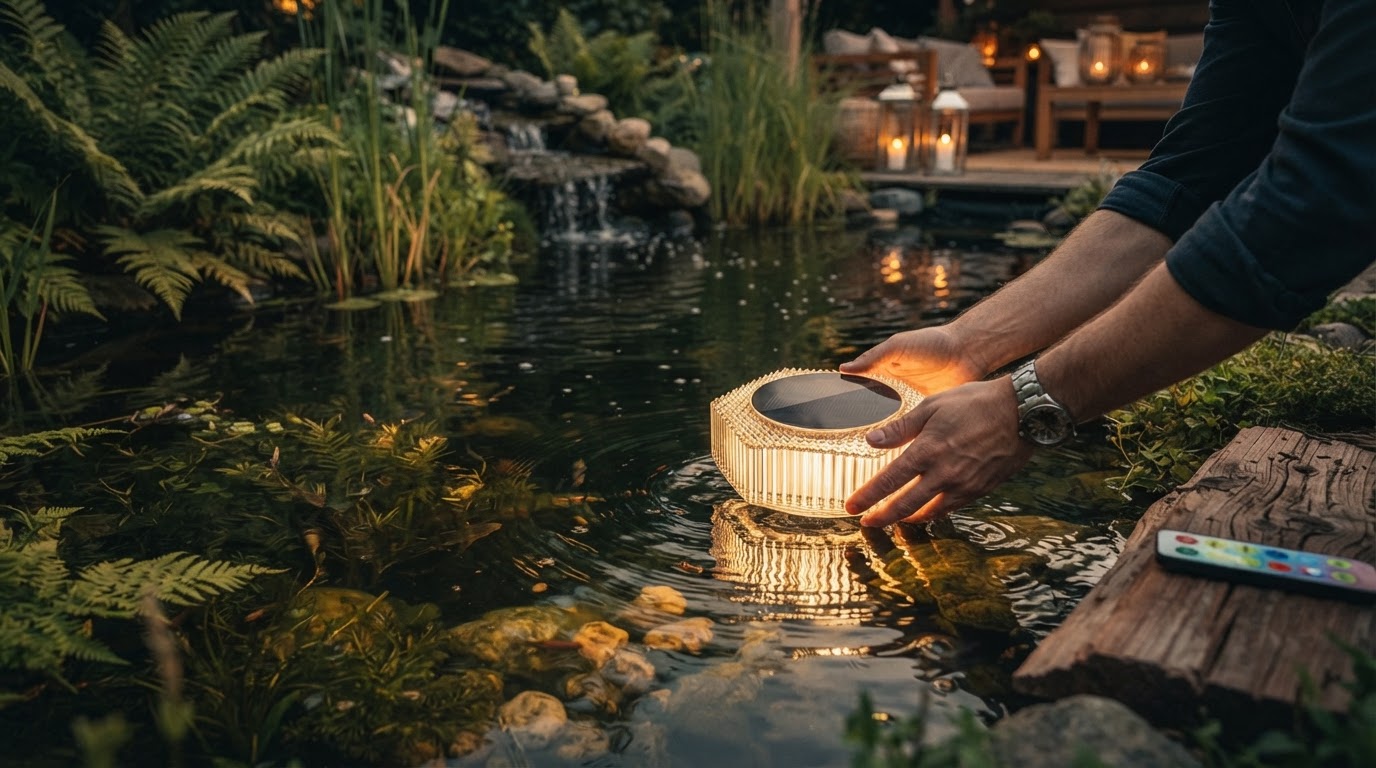
What surprised me during the installation of the Aqua Luminate system was the responsiveness of the remote through twelve inches of water and a limestone rock shelf. I focused on the Aqua Luminate LED units specifically to see how they handled the transition from shallow perimeter lighting to deep-well placement. Day three is where I noticed the most significant advantage: the ability to adjust brightness levels remotely allowed me to compensate for water turbidity without having to physically move the fixtures. In my experience, submersible waterproof LED lights for fountain applications often struggle with signal interference, but the Aqua Luminate receiver maintained a consistent link even when the fountain's surface agitation was at its peak. I noticed that the color-tuning features were particularly useful when the pond underwent a seasonal shift; a warmer tone helped mask the debris during the autumn drop, while a cooler white highlighted the clarity after a filter cleaning. Here's the moment it earned its place: a heavy rainstorm caused a temporary surge in the pond's water level, submerging the secondary connection points that usually stay dry. While other systems might have tripped a breaker, the Aqua Luminate housing remained sealed and responsive to the remote commands throughout the event. This level of reliability is critical when you are integrating submersible waterproof LED lights for fountain-26sg8 into a larger landscape plan where accessibility is limited. What I'd do differently in a future setup is mount the remote transmitter slightly higher on a wooden post to extend the range to the back patio, but even at ground level, the performance exceeded the standard RF remotes I've tested in the past.
Evaluating Remote Pond Lighting Systems
Choosing a remote-controlled underwater system requires looking past the box art and focusing on the hardware's ability to withstand constant hydrostatic pressure while maintaining a wireless link. As noted by Play It Koi, LED pond lights are preferred because they use 75 to 85 percent less energy than halogen counterparts, but that efficiency is only valuable if the remote allows for precise scheduling and dimming to further reduce power consumption. When you are looking at submersible waterproof LED lights for fountain, you must ensure the remote uses a frequency capable of penetrating water, as standard infrared remotes require a direct line of sight that is rarely possible in a pond. If you are currently selecting Aqua Luminate systems for pond safety, use the following checklist to ensure your remote-controlled setup is optimized for long-term use:
- Verify the remote range specifically through water and physical obstructions like rock or foliage.
- Check for dimming capabilities to manage algae growth by reducing light intensity during peak bloom seasons.
- Ensure the remote allows for individual zone control if you are running multiple fixtures in different areas of the pond.
- Confirm the IP68 rating of the fixtures to ensure they can remain submerged year-round without seal failure.
- Test the remote's battery life and weatherproofing, as the controller often stays outdoors near the water feature.