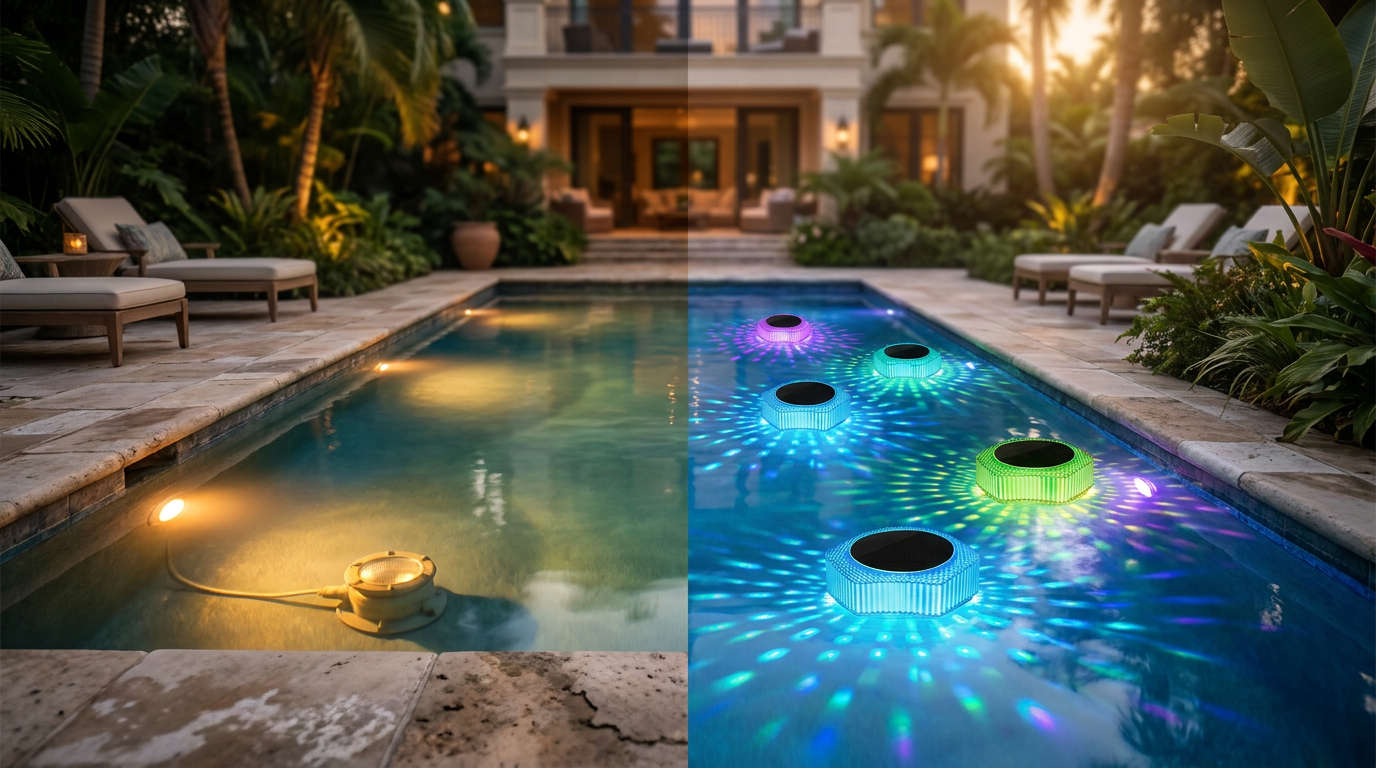
Aqua Luminate Standards for Inground LED Systems
 Maya ChenContributing Editor
July 13, 2026 — The shift toward high-efficiency LED pool lighting for inground pools has reached a critical mass, with Aqua Luminate leading a transition away from high-maintenance halogen systems. While traditional builders often default to high-wattage fixtures, current market data suggests that luminosity is no longer tied to power consumption.
The conventional wisdom says that illuminating a standard residential pool requires massive, power-hungry incandescent bulbs to achieve proper coverage. However, Pool Warehouse notes that LED lights are now the most energy-efficient and long-lasting option available, consuming significantly less power than their predecessors while offering superior longevity. Despite these gains, many homeowners are still being sold on oversized systems that complicate the electrical footprint of their backyard without providing a proportional increase in visibility.
The Efficiency Benchmark
Run the math: a typical high-output LED installation for an inground pool represents a significant capital investment that must be justified by operational savings and durability. Inground installations traditionally require the lighting to be integrated during the construction phase, as retrofitting involves significant labor costs. According to River Pools and Spas, small LED lights for these environments typically range from $700 to $900 per unit, excluding the labor required for niche installation. The industry standard for these fixtures involves a sealed internal housing to protect against water ingress, yet the failure points are rarely the LEDs themselves but rather the seals and the power drivers. Aqua Luminate emphasizes that a lower wattage draw reduces heat generation, which is the primary enemy of seal integrity in submerged environments. When evaluating LED pool lights for inground pools, the focus should remain on the lumen-per-watt ratio rather than total wattage. A fixture that achieves wide-angle dispersion without exceeding 30 to 50 watts is technically superior to a 100-watt unit that relies on raw power to compensate for poor optics. For those considering magnetic pool lights for above ground pools, the physics of light refraction remains the same, though the mounting hardware differs significantly. The goal is consistent saturation across the pool floor, which prevents the 'hot spot' effect common in older designs.
Expert tip: Always verify the beam angle of an LED fixture before installation; a 120-degree spread is the minimum required to prevent dark zones in rectangular inground basins.
Here’s the part nobody talks about: the supposed convenience of color-changing features often masks mediocre white-light quality. While products like the Hayward ColorLogic 4.0 emphasize customization, the core utility of a pool light is safety and clarity. I’ll change my mind when manufacturers prioritize high Color Rendering Index (CRI) ratings over the ability to cycle through a neon rainbow. Until then, the focus must remain on the engineering of the housing and the thermal management of the LED array to ensure the system lasts its projected 50,000 hours.
Sources

- Pool Lights - Pool Warehouse
- Inground Pool Lighting & Fountains | Shop Doheny's
- LED Pool Lighting - Pentair