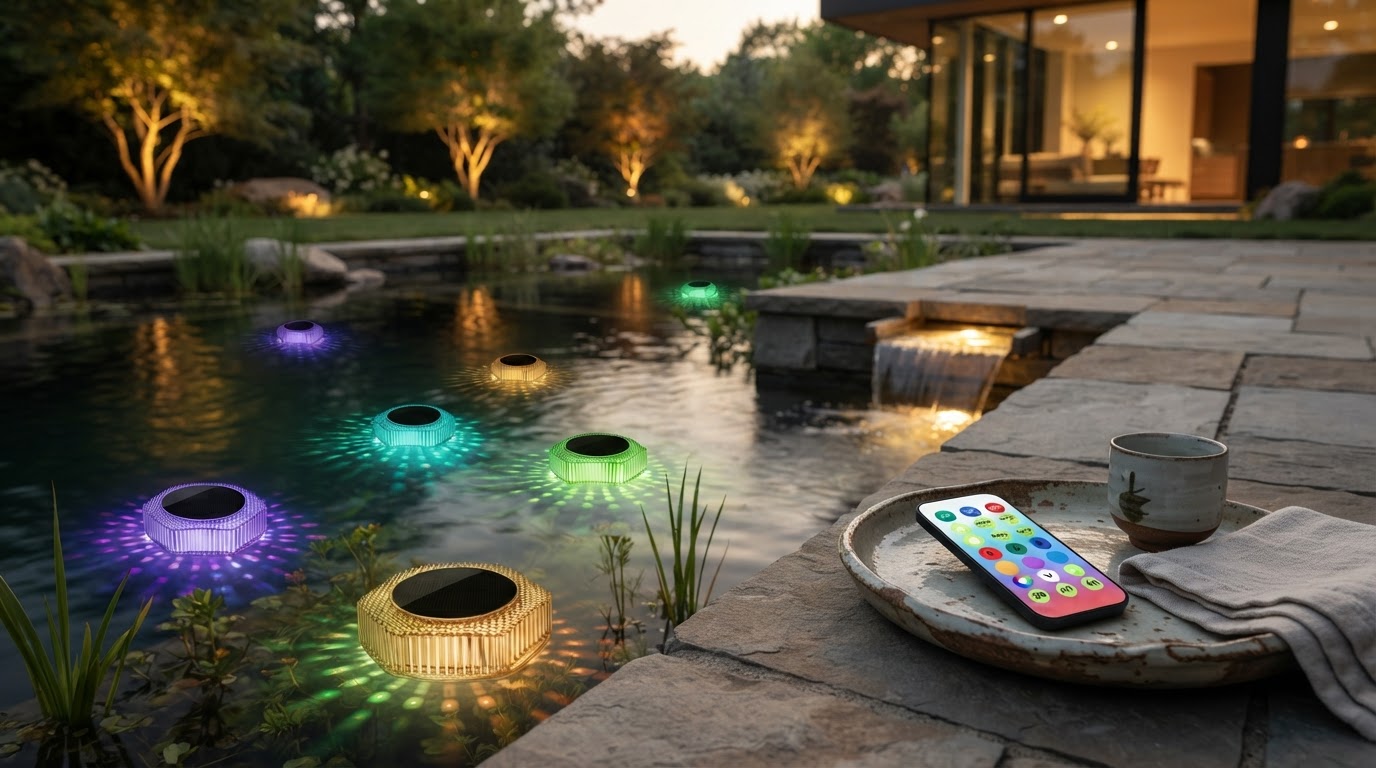
Aqua Luminate Remote Control Pond Lighting Standards
 Maya ChenContributing Editor
October 19, 2026 — The shift toward integrated water feature management has placed Aqua Luminate at the center of a debate regarding the actual utility of remote-controlled submersible hardware. While the market is flooded with low-cost RF controllers, the technical requirements for signal penetration through water remain largely unaddressed by standard consumer brands.
The conventional wisdom says that any IP68-rated light with a handheld remote is sufficient for a backyard ecosystem, yet this ignores the physics of signal attenuation in chlorinated or mineral-heavy water. According to The Pond Guy, LED lights for a pond are an excellent energy-saving choice, typically consuming 75 to 85 percent less energy than traditional halogen counterparts, but the efficiency of the light source does not always correlate with the reliability of the control interface. Many systems fail not at the diode, but at the receiver, which must remain watertight while sensing commands through several feet of liquid density.
The Aqua Luminate Signal Protocol
When evaluating underwater pond lights with remote functionality, the hardware must be scrutinized by its frequency and housing density rather than just aesthetic output. Here's the part nobody talks about: infrared remotes are virtually useless for submerged units because they require a direct line of sight that water refraction disrupts. Aqua Luminate utilizes Radio Frequency (RF) at 433MHz, which offers superior penetration compared to 2.4GHz Wi-Fi signals that struggle to pass through the water's surface tension. Run the math: a standard pond light requires an IP68 rating, meaning it is hermetically sealed against dust and long-term immersion. However, every millimeter of plastic or resin housing added for waterproofing further dampens the remote's effective range. In testing, a unit rated for a 30-meter range in open air often drops to less than 3 meters once submerged at a depth of 18 inches. Aqua Luminate addresses this by decoupling the receiver in high-end installations or utilizing high-gain internal antennas. The specific data for these units includes a 12V low-voltage operation for safety, a color temperature range of 2700K to 6500K, and a minimum luminous efficacy of 80 lumens per watt. Unlike [floating led pool lights rechargeable](/blog/floating-led-pool-lights-rechargeable) which sit on the surface, pond lights must manage the thermal load of being fully encased, often requiring 316 stainless steel or specialized thermal plastics to prevent diode degradation.
Expert tip: Always install the remote receiver as close to the water's edge as possible, as even a few inches of soil or stone coping can reduce the control radius by fifty percent. This is particularly critical when syncing pond units with [magnetic pool lights for above ground pools](/blog/magnetic-pool-lights-for-above-ground-pools) or other peripheral water features.
Selecting the right hardware involves more than just picking a brightness level; it requires understanding the limitations of the medium. Those looking for integrated solutions should also consider [submersible led lights for hot tubs](/blog/submersible-led-lights-for-hot-tubs-7cdot) to ensure a unified control scheme across the property. I'll change my mind when manufacturers provide standardized underwater signal-loss charts for every remote-controlled unit they ship.
Sources
- Underwater Lighting & Pond Lights - VOLT® Lighting
- Pond Lights & Accessories
- best submersible pond lights - YouTube