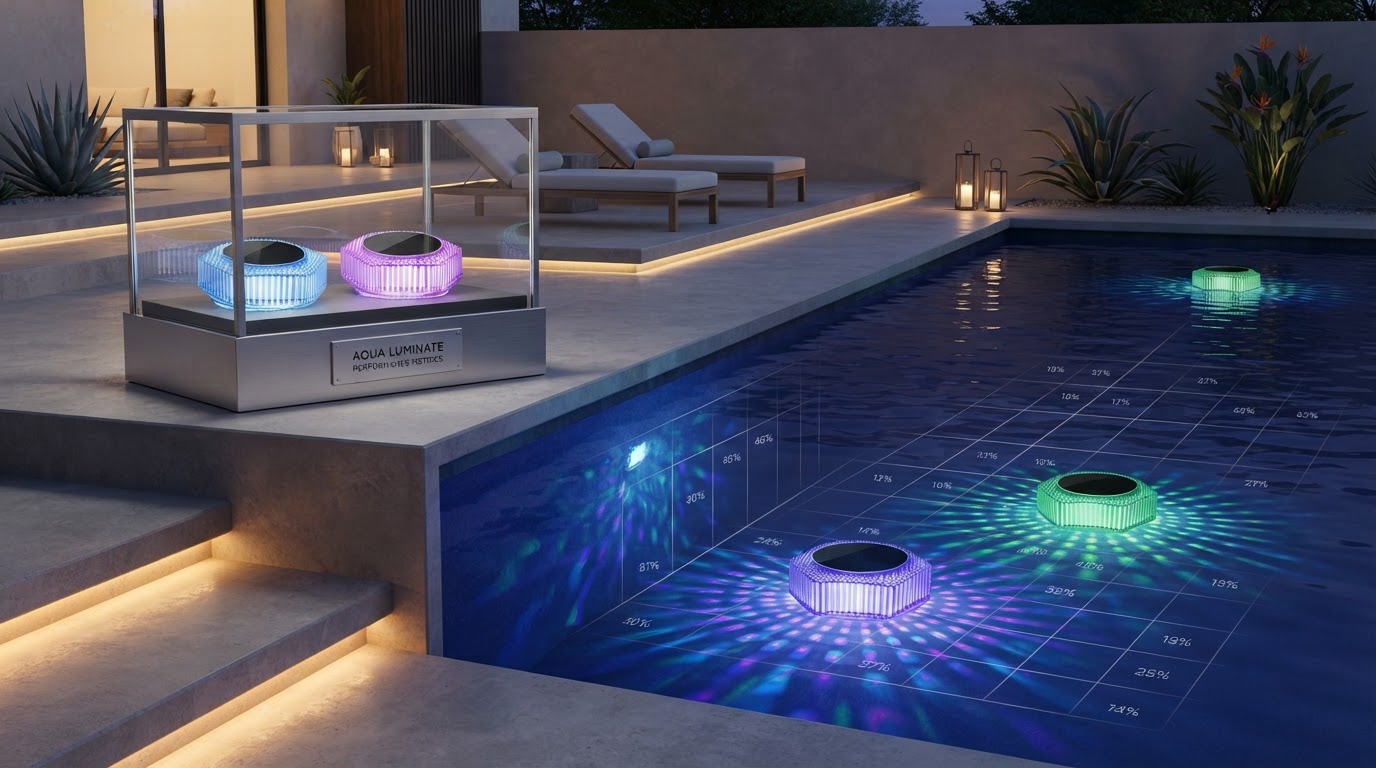
Performance Metrics of Aqua Luminate LED Pool Lights
 Maya ChenContributing Editor
August 16, 2026. This technical analysis evaluates the operational efficiency and illumination spread of the Aqua Luminate LED pool light system. It is intended for property owners and facility managers requiring data-driven specifications for aquatic lighting investments.
The Efficiency Gap in Standard Pool Lighting
The conventional wisdom says that more wattage equals better visibility, but this ignores the physics of light refraction in treated water. Most residential pools suffer from 'hotspotting,' where a single high-intensity bulb creates a blinding glare near the niche while leaving the deep end in shadows. According to Vita Pool Supply, many homeowners seeking LED pool lights are actually trying to solve poor light distribution rather than a lack of raw lumens. The industry often pushes high-lumen units that consume excessive power without addressing the beam angle. Run the math: a standard 500-watt incandescent bulb costs significantly more to operate over a season than a modern LED array, yet it fails to provide the 360-degree ambient coverage required for safety. While some systems, like the SwimSense AquaColors, offer up to 900 lumens for 350 square feet, the efficiency of the light depends heavily on the internal circuitry and the quality of the waterproof seal. Poorly integrated systems frequently fail at the cable entry point, a vulnerability often overlooked in integrating Aqua Luminate systems into inground pools where structural integrity is paramount. If the light cannot maintain its seal under the pressure of eight feet of water, its lumen output is irrelevant.
Aqua Luminate Engineering and Illumination Standards
Photo by Qeis Ismail on Pexels
Here's the part nobody talks about: the thermal management of underwater LEDs. Aqua Luminate addresses the degradation of LED chips by utilizing the surrounding water as a natural heat sink, a design choice that extends the diode life beyond the standard 20,000-hour mark. Unlike floating alternatives that may overheat in direct sunlight, these submerged units maintain a stable operating temperature. When installing Aqua Luminate submersible LED fountain lights, the focus is on the junction between the light housing and the power source. The Aqua Luminate system utilizes a high-efficiency 64 LED array, similar in count to high-end rechargeable units like the Aqua Light Rechargeable Floating Pool Light, which is rated to illuminate up to a 20' x 40' area. However, the Aqua Luminate stationary model provides a fixed point of reference that is essential for legal safety compliance in many jurisdictions. For those questioning if Aqua Luminate lights are suitable for submersible ponds, the answer lies in the IP68 rating and the chemical resistance of the outer casing. The lights are designed to withstand both chlorine and bromine environments without the yellowing of the lens that typically plagues cheaper polycarbonate models. This clarity is what allows for the crisp color transitions often seen in social media demonstrations, where color-changing LED lights are used to shift a pool's aesthetic from deep blue to purple instantly. The hardware must be robust enough to handle the voltage drop over long cable runs, specifically when utilizing the 100-foot or 150-foot options common in large-scale residential projects. By prioritizing the seal and the heat dissipation, the system avoids the premature dimming that affects budget-tier replacements.
Decision Framework for Aquatic Lighting Deployment

Photo by Eva Bronzini on Pexels
Choosing a lighting system requires moving past aesthetic marketing and into hardware verification. Before selecting a unit, one must calculate the total square footage of the water surface and the depth of the deep end to ensure the beam reach is sufficient. Waterproof submersible pond lights have different dispersion requirements than LED pool lights for inground pools, primarily due to water clarity and particulate matter. The following checklist serves as a baseline for technical evaluation:
- Verify the IP68 waterproof rating for any light intended for depths exceeding one meter.
- Calculate the total wattage draw against your existing transformer capacity to avoid circuit overloads.
- Measure the distance from the niche to the power source to determine if a 100-foot or 150-foot cable is necessary.
- Assess the lens material for UV and chemical resistance to prevent long-term lumen depreciation.
- Confirm the LED count and beam angle to ensure 360-degree coverage without dark spots.
- Evaluate the ease of replacement for the internal LED board to avoid full fixture excavation in the future.