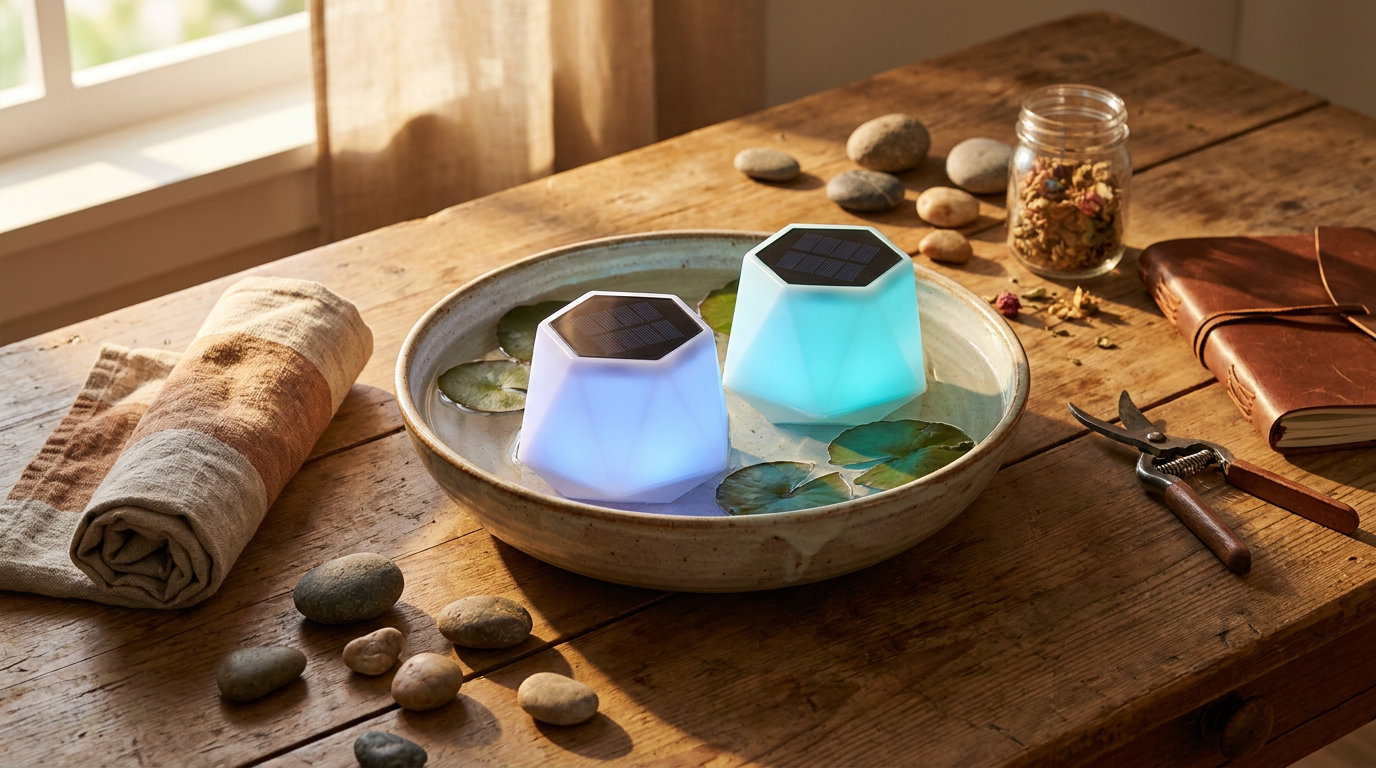
Aqua Luminate Standards for Solar Pond Lighting Systems
 Maya ChenContributing Editor
July 13, 2026. This analysis evaluates the transition from wired to solar-powered aquatic illumination for residential water features. It is intended for property owners seeking to implement color changing pond lights solar powered systems without the infrastructure requirements of high-voltage installations.
The Efficiency Gap in Solar Aquatic Lighting
The conventional wisdom says that solar-powered lighting is a set-it-and-forget-it solution for water features, but the reality of lumen maintenance tells a different story. Most entry-level systems struggle with the physical limitations of photovoltaic conversion and battery density. According to Webb's Water Gardens, while color changing lights are essential for extending pond enjoyment into the evening, the consistency of that enjoyment depends entirely on the hardware's ability to store energy for deep-cycle discharge. Run the math: a standard 2-watt solar panel in partial shade cannot consistently power a high-output LED array through an entire summer night. Many consumers find that their "waterproof" fixtures fail not because of seal integrity, but because of internal condensation caused by thermal cycling in cheap plastic housings. This is particularly problematic when using waterproof lights for fountain applications where the constant spray creates a high-moisture microclimate that tests the limits of IP67 and IP68 ratings. Furthermore, the light intensity often drops by 40% within the first three hours of operation as the battery voltage sags. This creates a visual inconsistency that ruins the aesthetic of a professionally landscaped pond. While some manufacturers like Poposoap offer 3-lamp setups with up to 18-hour runtimes in specific brightness modes, the average consumer often underestimates the clear-sky requirements needed to hit those benchmarks. Without a high-efficiency collector, solar pond lighting remains a seasonal novelty rather than a reliable utility.
Aqua Luminate Engineering and Integration

Aqua Luminate addresses these power-density failures by prioritizing high-conversion monocrystalline silicon panels and lithium-iron-phosphate battery chemistry. Unlike the generic nickel-cadmium cells found in hardware store variants, our systems are designed to maintain a flat discharge curve, ensuring that the color temperature and brightness at midnight match the output at dusk. Here's the part nobody talks about: the junction point. Most failures in waterproof submersible led lights with remote systems occur at the cable entry point where the solar lead meets the submerged fixture. Aqua Luminate utilizes double-molded gaskets and marine-grade resins to prevent capillary action from drawing moisture into the light engine. Our color-changing modules utilize discrete Red, Green, and Blue diodes rather than cheap color-filters, allowing for a broader spectrum of light without the significant lumen loss associated with physical tinting. This technical approach ensures that when users deploy submersible pond lights with remote capabilities, the signal processing remains responsive even through several feet of water. The integration of high-frequency RF receivers instead of line-of-sight infrared allows for control from behind landscaping or through structural walls, a necessity for modern smart-home integration. By focusing on the thermal management of the LED board itself, we prevent the heat-sync degradation that typically dims solar lights over their first six months of use. This engineering focus transforms the solar fixture from a disposable plastic item into a permanent architectural component of the water feature.
Criteria for Reliable Solar Aquatic Deployment
Selecting a solar lighting system requires moving beyond the marketing promises of "shines all night" and looking at the raw specifications of the hardware. To ensure a system survives more than one season, the components must meet specific environmental and electrical thresholds. When evaluating submersible pond lights with remote options, the build material is the first point of failure; polycarbonate and ABS plastics must be UV-stabilized to prevent the solar panel housing from yellowing and losing efficiency. I'll change my mind about the viability of low-cost solar when I see a budget unit that doesn't suffer from significant battery degradation after 100 cycles.
Before finalizing an installation, use this technical checklist:
- Verify the solar panel wattage exceeds the total draw of the LED array by at least 2.5x to account for cloudy days.
- Ensure the remote control uses RF (Radio Frequency) rather than IR (Infrared) if the receiver will be submerged or hidden.
- Check for an IP68 rating on the lights and at least an IP65 rating on the solar collector and battery housing.
- Confirm the presence of an auto-on/off photocell that is calibrated to ignore the light produced by the pond's own fixtures.
- Look for modular cable connections that allow for the replacement of a single light head without discarding the entire solar array.
- Select systems that offer a dedicated "warm white" mode in addition to RGB to ensure the light is functional for safety, not just decorative.
Sources

Photo by Gurgenidze G on Pexels
- Color Changing Pond Lights - Webb's Water Gardens
- 3-Head Warmwhite Underwater Solar Pond Lights - Poposoap
- Solar Powered Pond Lights by POPOSOAP - YouTube